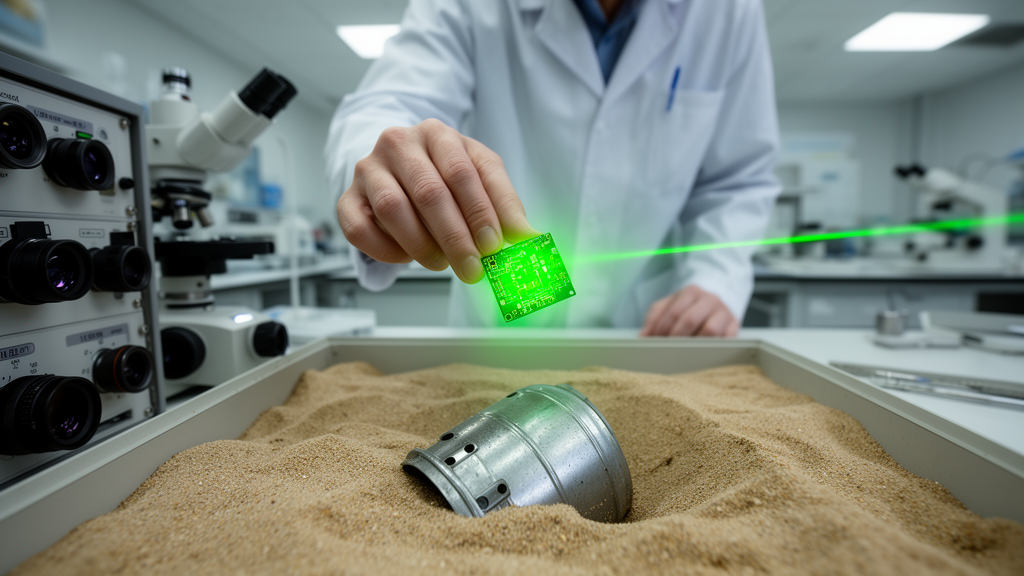
Landmines and unexploded ordnance still contaminate more than 60 countries and cause thousands of casualties every year, yet the tools used to find them have changed surprisingly little. A new theoretical study now proposes a way to combine one of the most sensitive magnetic sensors in physics with a coordinated fleet of small robots, and reports striking simulated performance numbers — while stressing that nothing has yet been demonstrated in the field.
The framework, called the Quantum-Enhanced Swarm Intelligence Network, or QESIN, is the work of an independent researcher and is published as a simulation-based study in the journal Biosensors and Biomolecular Electronics. Its central idea is to mount nitrogen-vacancy, or NV, center magnetometers — quantum sensors built from defects in diamond — onto swarm robots that sweep suspect ground together, fusing their readings with hyperspectral imaging, thermal imaging and ground-penetrating radar through a hierarchical Bayesian model.
The motivation comes from well-documented weaknesses in conventional demining technology. Traditional metal detectors achieve sensitivities of 10 to 100 nanotesla but suffer false alarm rates of up to 50 percent in mineralized soils, driving clearance efficiency below 50 percent and pushing costs above one million dollars per square kilometer. Ground-penetrating radar offers subsurface imaging with 0.1 to 1.1 meter resolution but becomes markedly less reliable in moist conditions, where false positives can rise by 40 percent. Non-metallic mines containing TNT or RDX, whose magnetic susceptibilities fall below 10 to the minus fifth SI units, are especially hard to spot; UAV-based hyperspectral imaging manages detection rates of only around 70 percent because of centimeter-scale resolution limits and atmospheric interference.
NV center magnetometry addresses the sensitivity gap at a fundamental level. The sensor exploits the spin-1 ground state of the nitrogen-vacancy defect, whose behavior is described by a Hamiltonian incorporating a zero-field splitting of about 2.87 gigahertz, a transverse strain-induced splitting below 10 megahertz, an electron gyromagnetic ratio of 28 gigahertz per tesla, and hyperfine and quadrupole terms from the embedded nitrogen nucleus. These parameters are empirically validated through optically detected magnetic resonance spectroscopy, and the modeled sensitivity reaches below one picotesla per square root hertz — orders of magnitude finer than conventional metal detectors.
A key strength of the study is that it does not hide from its own noise model. The simulations incorporate Gaussian white noise of 5 picotesla standard deviation, correlated geophysical noise generated by an Ornstein-Uhlenbeck process with correlation times of a microsecond and amplitudes of 1 to 10 nanotesla to mimic mineralized soils, and thermal noise at room temperature that limits the coherence time to about 100 microseconds. The author calculates that this geophysical noise degrades the signal-to-noise ratio by 15 to 20 percent and could drag detection efficiency down from 98.2 percent to 80 percent if left unmitigated; advanced pulse sequences such as Hahn echo and Bayesian filtering are modeled as the countermeasures that restore benchmark performance.
The swarm component relies on Lévy flight-based exploration, with a power-law step distribution whose exponent is optimized at 1.5, augmented by reinforcement learning for obstacle avoidance. The modeled agents carry assumptions drawn from field prototypes: two-hour battery life, a 50-meter communication radius and a speed of 0.5 meters per second. Connectivity across the swarm is maintained using spectral graph theory, ensuring that the algebraic connectivity of the communication graph stays above zero. According to prior work cited in the study, Lévy flight search strategies improve coverage by about 25 percent over traditional grid searches.
The statistical core of the framework is a hierarchical Bayesian fusion model that computes posteriors from multi-modal sensor data using Gaussian process priors to capture spatial correlations. Variational inference separates aleatoric uncertainty, fixed at 0.01 in the model, from epistemic uncertainty, which is reduced by 90 percent through multi-modal integration. A further extension targets non-metallic explosives directly: hyperspectral signatures are flagged via Mahalanobis distance anomalies and fused with NV relaxometry, in which the relaxation rate scales linearly with the concentration of trace nitro compounds, with a modeled 20 percent relaxivity penalty from noise.
The headline results come from Monte Carlo simulations on a 100 by 100 meter grid containing 50 mines, run over 10 million data points with 10,000 bootstrap resamples. The simulated framework achieved a detection efficiency of 98.2 percent, with a 95 percent confidence interval of 97.5 to 98.9 percent, a precision of 0.92, an F1-score of 0.95, a ROC-AUC of 0.992, and a reduction in false positives of more than 80 percent compared with baseline methods reaching 85 percent efficiency. Sensitivity analysis showed efficiency dropping by roughly 1.5 percent for every 0.01 increase in noise, and statistical tests — a Welch t-test on posterior probabilities and a one-way ANOVA on the Lévy exponent — rejected equivalence with baselines at p-values below 10 to the minus 10 and 10 to the minus 12 respectively.
These numbers, however impressive, describe simulated terrain with uniform assumptions, and the author is explicit about the gap. Diverse soil types vary significantly in their geophysical noise, so field performance may be overestimated. Integrating NV sensors, which require lasers and microwave electronics, onto small robots poses serious size, weight and power challenges, along with self-generated magnetic noise from robot motors that would demand magnetic shielding or advanced calibration. Coordinating large swarms in cluttered environments adds a further scalability problem. The study notes that miniaturized NV magnetometers currently under development could ease some of these constraints, and that recent millimeter-scale NV magnetometers have already detected hidden metallic objects simulating landmines.
To bridge that gap, the paper lays out a proposed experimental protocol aligned with international humanitarian demining standards, though it remains a plan rather than a completed validation. Laboratory work would pair commercial NV magnetometers with modular robot platforms, using a 515 to 532 nanometer laser, microwave antennas from 1 to 5 gigahertz, and Helmholtz coil calibration verified to within 0.12 microtesla. Controlled field tests on a 100 by 100 meter site would bury inert mines at depths of 5 to 30 centimeters in varied soils, deploying a mixed fleet of robots for surface detection, electromagnetic induction, ground-penetrating radar and quantum magnetometry, supported by UAV-mounted hyperspectral cameras. Full-scale trials with demining organizations such as UNMAS and the HALO Trust would follow on non-operational sites. Until such empirical testing is done, QESIN remains a carefully modeled proposal — a quantum-sensing architecture whose simulated 98.2 percent detection efficiency and 0.992 ROC-AUC define a target, not a proven field capability.
Subject of Research: A theoretical simulation framework combining NV-center quantum magnetometry and swarm robotics for landmine detection
Article Title: A simulation-based quantum-enhanced swarm intelligence framework for landmine detection using NV centers in diamond
Article References: Shibah, S. R. M. (2026). A simulation-based quantum-enhanced swarm intelligence framework for landmine detection using NV centers in diamond. Biosensors and Biomolecular Electronics, 1(1), Article 2. https://doi.org/10.1186/s44510-026-00001-8
Image Credits: AI Generated
DOI: 10.1186/s44510-026-00001-8
Keywords: landmine detection, NV centers, quantum magnetometry, swarm robotics, Bayesian sensor fusion, Monte Carlo simulation, humanitarian demining, hyperspectral imaging, ground-penetrating radar, trace explosives, simulation study, simulation-based
News Source: Katie Riggs. (October 29, 2026). Simulated swarm of quantum diamond sensors could sharpen landmine detection. Scienmag.